
EPISODE #262 · SCIENCE & TECHNOLOGY
Can AI Actually Tell Us How to Live Better?
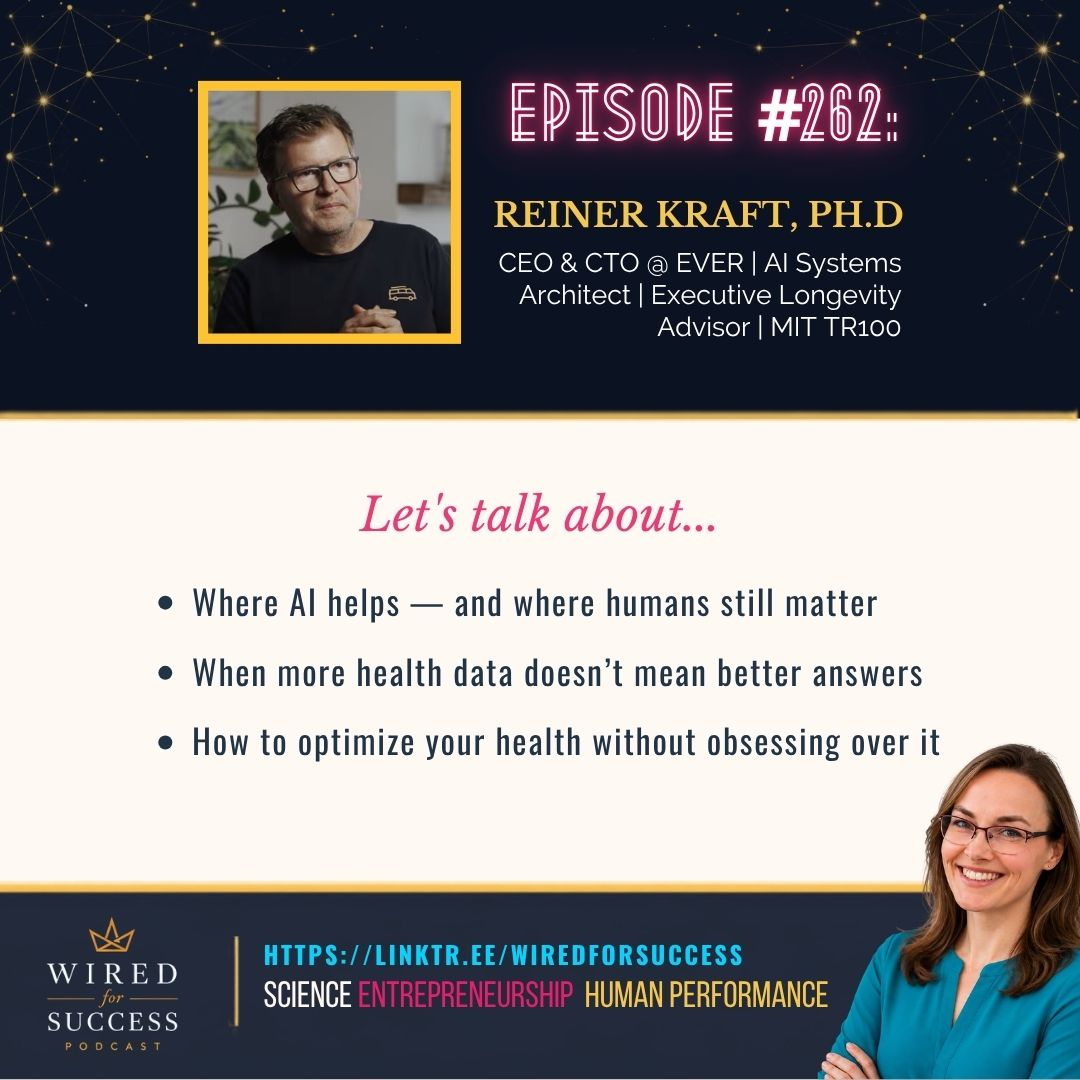
Computer scientist and EVER Health founder Reiner Kraft, Ph.D., explores what AI and biomarkers can genuinely reveal about our health—where personalised recommendations help, where they can mislead, and why human judgement still matters.
ABOUT THE GUEST
Reiner Kraft, Ph.D.
Reiner Kraft, Ph.D., is a computer scientist, former Silicon Valley technology executive, researcher and inventor with more than 120 registered US patents. After roles at IBM Research, Yahoo and Zalando, he turned his systems-thinking approach toward personalized health and prevention and founded EVER Health.
EXPLORE MORE
Science & Technology
Discover conversations about health, artificial intelligence and the technologies shaping our future—less jargon, more actionable tips and insights.
More health data. Better health decisions?
We have more information about our health than ever before.
Our watches track our sleep, heart rate and recovery. We can test dozens of biomarkers, sequence our DNA and monitor all sorts of things most of us had never even heard of ten years ago.
And now, of course, we can throw AI into the mix.
As a scientist and unapologetic data nerd, I find all of this incredibly exciting. But I also have questions. Lots of them.
Because more data doesn’t automatically mean better decisions. And a beautifully personalized recommendation can still be beautifully wrong.
So when I sat down with computer scientist and EVER Health founder Reiner Kraft, Ph.D., I wanted to explore both sides of this new world of AI-powered personalized health: what can these technologies genuinely help us understand about ourselves—and where might we be getting a little ahead of the science?
Reiner is an interesting person to ask. Before turning his attention to health, he spent more than two decades in technology, including roles at IBM Research, Yahoo and Zalando, and has more than 120 registered US patents. He now applies that engineering mindset to health, prevention and human performance.
What followed was a conversation about AI, biomarkers and personalized health, but also about something much more fundamental:
How much information do we actually need to live well?
Where AI helps—and where humans still matter
One thing I appreciated about our conversation was that Reiner, despite building AI-powered health technology himself, certainly wasn’t suggesting that we should hand over our health decisions to an algorithm and call it a day.
Quite the opposite.
AI is very good at dealing with complexity. Feed it biomarkers, lifestyle information and other health data and it can find patterns that would be extremely difficult for one human brain to juggle simultaneously.
That sounds fantastic.
The problem is that finding a pattern and knowing what that pattern means are not the same thing.
A correlation isn’t necessarily causal. A biomarker outside the “optimal” range isn’t automatically a problem. An intervention that makes sense statistically might not improve the outcome you actually care about.
And, as Reiner pointed out during our conversation, current AI systems still make mistakes. When we’re talking about our health rather than asking ChatGPT to plan a dinner party, the consequences of confidently getting something wrong become rather more important.
This is why EVER Health keeps humans in the loop.
For me, that’s one of the most interesting questions in this whole space. Not simply: Can AI give us an answer? But: Do we have enough evidence to know whether it’s the right answer?
Is more health data actually better?
This is where I’m a little skeptical. I think we are mostly unaware of the underlying machinery for a reason. If it were beneficial to obsess over every little detail, evolution would probably have built us differently.
I’m fascinated by personalized health, but I also wonder whether our enthusiasm for measuring everything occasionally gets ahead of our ability to interpret what we’ve measured.
Imagine we test enough biomarkers and collect enough data about one person. Eventually, we’re almost guaranteed to find something that looks unusual.
Great. Now what?
Is it clinically important? Is it causing anything? Can we change it? And—most importantly—will changing it actually make the person healthier, happier or better able to function?
Those are very different questions.
This led us into a discussion I found particularly interesting: rather than asking how much data we can collect, maybe we should also be asking what the smallest useful model might be.
What are the handful of measurements, behaviors and interventions that actually help someone make better decisions?
Because I can imagine a future in which we know 4,723 things about our bodies at any given moment and are somehow less certain about what to have for breakfast.
I’m not convinced that’s progress.
When optimizing your health becomes… unhealthy
There is also a rather wonderful irony lurking inside the whole health-optimization movement.
You can eat perfectly, exercise intelligently, monitor your biomarkers, optimize your sleep, track your recovery and carefully engineer your morning routine…
…and then spend so much time worrying about all of it that you’ve created an entirely new source of stress.
Entrepreneurs may be particularly vulnerable to this because we’re rather good at turning things into projects.
Sleep becomes a score. Exercise becomes a performance metric. Food becomes a spreadsheet. And suddenly being healthy is another thing you’re failing to do efficiently enough.
What I liked about Reiner’s own experience is that his routine has actually become simpler as he’s learned more about himself. Once he’d identified the things that seemed to matter most, he could put much of his health routine on what he calls “autopilot.”
That struck me as a much more appealing end point for personalized health.
Not spending more and more of our lives thinking about our health. Using better information to make good decisions—and then getting on with our lives.
Have nutrients in modern foods really declined?
One claim in our conversation sent me down a little research rabbit hole afterwards.
We talked about the idea that modern fruits and vegetables contain fewer nutrients than they used to. I’d heard versions of this claim before, but couldn’t remember the actual papers or how convincing the evidence was. So I went looking.
And, as so often happens when you actually read the research, the answer appears to be: Yes… but it’s complicated.
A widely cited 2004 study by Davis and colleagues compared USDA food-composition data for 43 garden crops between 1950 and 1999. Across those crops, the researchers found statistically reliable declines in six of the nutrients they examined, with median reductions ranging from 6% for protein to 38% for riboflavin.
One possible explanation is what’s known as the dilution effect. If we breed crops to produce more yield, the increase in carbohydrates or dry matter doesn’t necessarily come with an equivalent increase in every nutrient.
Interestingly, a much more recent analysis looked at UK food-composition data stretching all the way from 1940 to 2019 and also reported declines in several minerals.
So there does seem to be a signal here.
But before we collectively abandon the vegetable aisle and start living on supplements, there are some fairly important caveats.
Comparing food-composition tables across 50 or 80 years is messy. Crop varieties change. Growing conditions change. The geographical origin of the food changes. Sampling changes. Laboratory methods change.
A critical review published in 2017 found evidence supporting a dilution effect in some high-yield crops, but pushed back against the much bigger claim that modern agriculture has caused some universal, nutritionally devastating collapse in our food supply.
Takeaway
There’s enough evidence here to make nutrient decline a genuinely interesting question.
There’s not enough, in my view, to turn that into a blanket statement that “our food has lost 50–70% of its nutrients” or that everybody therefore needs to take supplements.
Those are much bigger conclusions.
Science is annoyingly fond of nuance like that. 😉
I have a feeling that supplements become more useful as we age, rather than being something everyone needs as a general prescription. Personally, I started taking supplements a few years ago and have noticed a clear improvement in my energy and overall wellbeing. Unfortunately, N=1 experiments are still the most useful experiments here…
So… can AI actually tell us how to live better?
After talking to Reiner, I don’t think the answer is a straightforward yes or no.
AI gives us some genuinely exciting new tools. It can process huge amounts of information, spot patterns and potentially make sophisticated health information much more useful and accessible to individuals.
But an algorithm can’t magically fix gaps in the underlying science.
If we don’t yet know whether something is causal, measuring it more precisely doesn’t solve the problem. If experts disagree about what a biomarker means, encoding their assumptions into software doesn’t suddenly make the disagreement disappear.
And more information isn’t necessarily useful if we don’t know what deserves our attention.
So perhaps the sweet spot, at least for now, looks something like this:
Good data + useful technology + solid science + human judgment.
With enough common sense left over to occasionally put down the health tracker, eat the chocolate and go outside.
That sounds pretty healthy to me.
FULL EPISODE
Listen to the full conversation
Hear where AI genuinely helps, why more health data does not always produce better answers, how to optimize your health without obsessing over it, and why human expertise still matters.
Research & further reading
- Changes in USDA food composition data for 43 garden crops, 1950 to 1999Davis DR, Epp MD, Riordan HD. Journal of the American College of Nutrition, 2004.
- Historical changes in the mineral content of fruit and vegetables in the UK from 1940 to 2019Mayer AMB, Trenchard L, Rayns F. International Journal of Food Sciences and Nutrition, 2022.
- Mineral nutrient composition of vegetables, fruits and grains: The context of reports of apparent historical declinesMarles RJ. Journal of Food Composition and Analysis, 2017.
Continue exploring
- What Smart Underwear Could Reveal About Women’s HealthSmart textiles, reproductive-health data and the limits of AI-generated insights with Fibra founder Parnian Majd.
- Preventative Brain Health & Salivary BiomarkersPrecision diagnostics, cognitive resilience and the future of preventative health with neuroscientist Dr. Lavinia Alberi Auber.
- Explore all Science & Technology episodes →
Music credit
“Vittoro” by Blue Dot Sessions
sessions.blue
Disclaimer
This podcast is for educational and informational purposes only and does not constitute medical or financial advice. Episodes may contain sponsored content.