
EPISODE #263 · SCIENCE & TECHNOLOGY
What Smart Underwear Could Reveal About Women’s Health
Fibra founder Parnian Majd is developing sensor-enabled underwear designed to capture reproductive-health signals other wearables miss. We explore what it measures, what AI can infer—and why more intimate data does not automatically mean better health decisions.
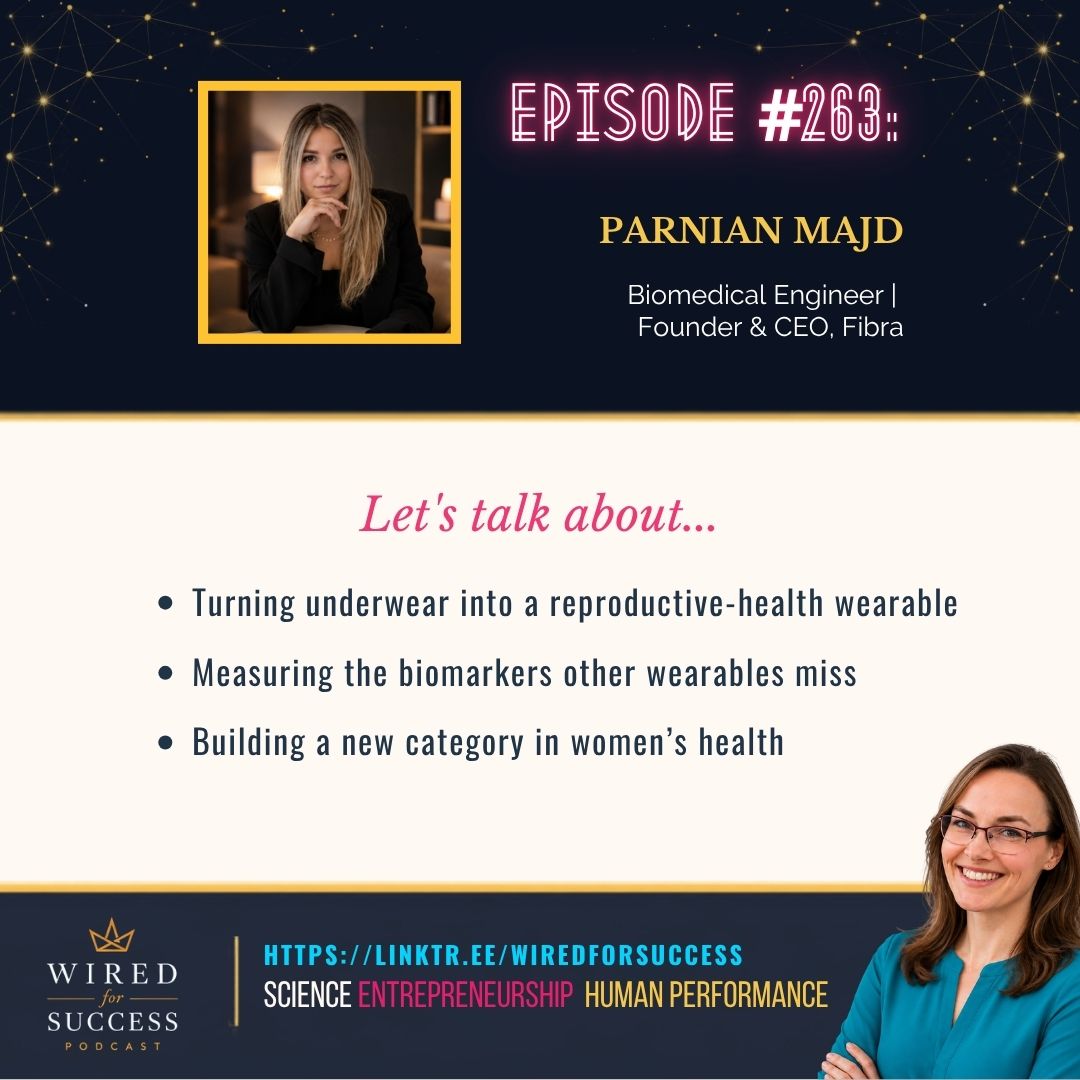
ABOUT THE GUEST
Parnian Majd
Parnian Majd, B.Eng., M.Eng., is a biomedical engineer and the founder and CEO of Fibra, a women’s-health technology company developing smart-textile underwear for continuous reproductive-health monitoring and personalised insights.
EXPLORE MORE
Science & Technology
Discover conversations about health, artificial intelligence and the technologies shaping our future—less jargon, more actionable tips and insights.
Yes, you read that right – smart underwear!
Smarty pants are becoming a real thing…
Jokes aside, what Parnian Majd is building at Fibra raises a much bigger question. We can track our sleep, steps and heart rate around the clock, yet much of reproductive health is still understood through symptoms, occasional tests and population averages. What might change if we could watch some of that biology unfold from day to day?
I find that possibility genuinely exciting. I also think it deserves more scrutiny than the usual “more data must be better” story. A sensor can produce a number. That does not automatically make the number accurate, meaningful or useful.
Why look beyond the wrist?
Parnian came to this problem through personal experience. She was diagnosed with PCOS as a teenager after years of irregular cycles and frustratingly few answers. Later, while studying biomedical engineering and working with biosensors, she began wondering why reproductive physiology had been largely left out of the wearable revolution.
Her answer was to move the sensor closer to the biology. Fibra is developing underwear with fabric-based sensors, a detachable electronic unit and a companion app. In our conversation, Parnian describes measuring signals such as vaginal discharge pH, patterns and volume, alongside secondary measures including abdominal temperature and heart-related data.
That is a very different proposition from asking a watch or ring to infer reproductive changes from the wrist. It could open a window onto signals that consumer wearables usually miss. But it also moves the technology into a far more intimate part of life, where accuracy, privacy and clear communication matter enormously.
A biological movie is only useful if we can understand it
One-off tests give us snapshots. Continuous monitoring can give us something closer to a movie, and biology often makes more sense when we can see change over time. The catch is that movies contain a lot more noise.
Vaginal pH is a good example. An elevated pH is one of the clinical clues used when assessing bacterial vaginosis, but it is not a diagnosis by itself. Semen, cervical secretions, other infections and even some products can shift the measurement. Research comparing diagnostic criteria has found pH useful as part of a wider assessment, while also showing that it can have poor specificity on its own.
That’s why I was curious: What exactly is the sensor measuring? How reliably does it measure it? What biological state is the algorithm trying to infer? And has that interpretation been tested against a meaningful reference standard in the people who will actually use it?
Those are separate questions. A widely used validation framework for digital health technologies makes the same distinction: first verify that the hardware works, then establish that the algorithm measures what it claims to measure, and only then ask whether the result has clinical meaning in a defined context. That is a much higher bar than quoting one impressive-sounding accuracy percentage.
Fibra is currently positioned as a wellness product rather than a diagnostic device. That distinction matters. The idea can be promising without every possible health application already being proven.
The trouble with textbook cycles—and textbook data
One of my favourite moments in the conversation had nothing to do with sensor engineering. Parnian recalled an investor insisting that ovulation happens on a fixed day of the menstrual cycle. Anyone with irregular cycles will immediately see the problem…
I looked this up and found that, in a prospective study, Wilcox and colleagues found that the fertile window could occur across a surprisingly wide range of cycle days; only around 30% of women had their entire fertile window within the days conventional guidance would predict. A later analysis of more than 600,000 cycles also showed substantial variation in cycle length and in the phase before ovulation. Day 14 may be a tidy teaching shortcut, but biology has never been especially interested in tidiness.
The wider data gap is not imaginary either. Analyses of biomedical research have documented longstanding male bias, including heavy reliance on male animals in several fields and a frequent failure to analyse results by sex. The situation has improved in some areas, but an algorithm cannot recover information that was never collected. It can just make the blind spot look more sophisticated.
This is why I am interested in Fibra’s ambition to build longitudinal, more representative datasets—and cautious about what those datasets can support. Personalisation could be useful for people whose bodies do not follow population averages. It still needs diverse participation, well-defined outcomes and honest uncertainty. I liked hearing that the app shows users a confidence level. The next question is whether that confidence is well calibrated and understandable outside the engineering team.
The founder challenge: building a category people cannot yet see
There is a fascinating entrepreneurship story underneath the science. Parnian has often had to explain the problem before she could even begin explaining the product. Potential customers, she says, understood the need much faster than many investors did.
That contrast is a useful reminder for founders working in neglected markets: talk to the people living with the problem before becoming too attached to your first solution. Fibra changed repeatedly through beta testing and customer feedback. The earliest idea was not simply polished until it became the current product; parts of it had to be reconsidered.
Parnian’s personal connection to the mission clearly gives her stamina. It also makes switching off harder. She now protects time for exercise because she knows she cannot keep contributing at the same level when she is exhausted. Smart textiles may be the futuristic part of this episode, but that may be the most immediately useful founder lesson in it.
Takeaway
I came away genuinely curious to see where Fibra goes—and how much it might contribute to closing the women’s-health data gap.
And most importantly, the question is not whether we can collect more intimate data. We almost certainly can. It is whether the measurements are robust, the interpretation is responsible and the resulting information helps women make better decisions without turning normal biological variation into another source of anxiety.
Technology will not close the women’s-health data gap on its own. Research design, funding, clinical practice, access and bias all play a part. But a tool that helps us observe previously overlooked signals could help researchers and clinicians ask better questions. Sometimes that is how a new scientific—and commercial—category starts.
FULL EPISODE
Listen to the full conversation
Hear how Parnian’s experience with PCOS led to Fibra, what the smart textiles are designed to measure, where AI-generated insights can go wrong, and what she has learned while building an entirely new category in women’s health.
Research & further reading
- Sex bias in neuroscience and biomedical research
Beery AK, Zucker I. Neuroscience & Biobehavioral Reviews, 2011. - The timing of the fertile window in the menstrual cycle
Wilcox AJ, Dunson D, Baird DD. BMJ, 2000. - Real-world menstrual-cycle characteristics from more than 600,000 cycles
Bull JR et al. npj Digital Medicine, 2019. - Diagnostic value of Amsel’s clinical criteria for bacterial vaginosis
Mohammadzadeh F et al. Global Journal of Health Science, 2015. - Verification, analytical validation and clinical validation of biometric monitoring technologies
Goldsack JC et al. npj Digital Medicine, 2020.
Continue exploring
- Can AI Actually Tell Us How to Live Better?
AI, biomarkers and the limits of personalised health data with Reiner Kraft, Ph.D. - Preventative Brain Health & Salivary Biomarkers
Precision diagnostics, cognitive resilience and the future of preventative health. - Explore all Science & Technology episodes →
Music credit
“Vittoro” by Blue Dot Sessions
sessions.blue
Disclaimer
This podcast is for educational and informational purposes only and does not constitute medical or financial advice. Episodes may contain sponsored content.