
EPISODE #261 · HUMAN PERFORMANCE
Why Some Leaders Inspire People (And Others Never Will)
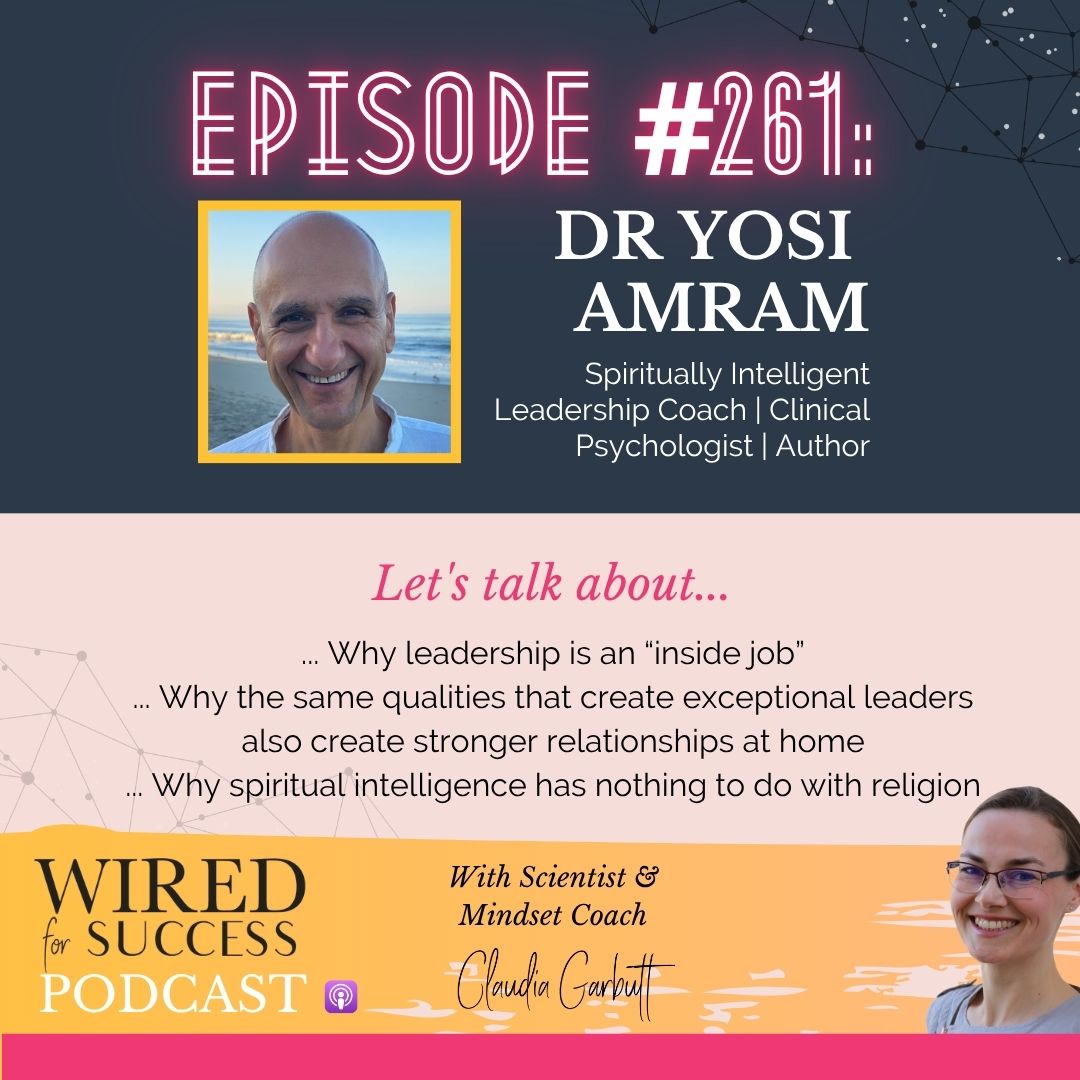
Psychologist, former tech CEO and spiritual-intelligence researcher Yosi Amram, Ph.D., explores why truly inspiring leadership begins on the inside—and how purpose, presence and integrity change the way we lead, work and live.
ABOUT THE GUEST
Yosi Amram, Ph.D.
Yosi Amram, Ph.D., is a licensed clinical psychologist, executive coach, author and pioneering researcher in spiritual intelligence. Before becoming a psychologist, he founded and led two technology companies through successful IPOs. His work explores how purpose, compassion, integrity, humility and presence can strengthen leadership effectiveness and wellbeing.
EXPLORE MORE
Human Performance
Explore conversations about mindset, leadership, resilience and sustainable success—without sacrificing your health, relationships or humanity along the way.
Why do some leaders inspire people—and others never quite manage it?
We tend to assume that inspiring leadership is primarily about what people can see: a compelling vision, confident communication, charisma or the ability to command a room.
But what if the most important part happens somewhere much quieter?
In my conversation with psychologist, former technology CEO and spiritual-intelligence researcher Yosi Amram, Ph.D., we explored an intriguing contradiction. The leaders who create the deepest trust and commitment are not necessarily the ones working hardest to project success. They are often the ones who have learned how to reconnect with themselves.
That matters because leadership is not merely a collection of techniques. You can learn how to speak persuasively, build a strategy and manage performance. But people also respond to something harder to manufacture: whether your words, values and behaviour genuinely align.
Before you can build a movement, lead a team or create something meaningful, there is therefore a more uncomfortable question to answer:
Are you building from inner alignment—or are you running on ambition alone?
Leadership is an inside job
Yosi’s route into this work was anything but conventional. He began his leadership journey in the Israeli military, later earned engineering degrees from MIT and an MBA from Harvard, and built two technology companies that went public.
On paper, that looked like success.
Internally, however, the story was more complicated. His experience eventually led him away from technology leadership and into psychology, executive coaching and the academic study of spiritual intelligence.
That history gives him an unusually practical perspective. He is not talking about leadership from a mountaintop while conveniently avoiding budgets, deadlines and difficult people. He has experienced the pressure of building companies—and the personal cost of trying to lead from drive alone.
One of the central ideas in our conversation was that you cannot sustainably inspire other people if you are completely disconnected from what inspires you.
A leader may be able to generate energy through force of personality for a while. But if the inner reality is exhaustion, insecurity or a constant need for validation, maintaining that performance becomes increasingly expensive.
What spiritual intelligence actually means
The phrase “spiritual intelligence” can sound religious, mystical or rather difficult to pin down. Yosi uses it in a more practical and inclusive way.
He describes spiritual intelligence as the ability to draw on and embody qualities such as purpose, compassion, gratitude, integrity, humility and presence in everyday life. It does not require belief in a particular religion—or even belief in God.
That distinction matters. The conversation is not about adopting someone else’s worldview. It is about developing the internal resources that help us respond with greater wisdom and humanity.
For leaders, those qualities are not merely pleasant additions to “real” business skills. Purpose helps people understand why their work matters. Compassion and deep listening improve trust. Integrity creates consistency between what a leader says and what they actually do. Humility makes learning possible.
And presence may be one of the most underrated leadership skills of all. People notice when you are genuinely with them—and when you are simply waiting for your turn to speak.
Managing people is not the same as inspiring them
You can manage through authority, incentives and clear expectations. Sometimes that is exactly what a situation requires.
Inspiration is different.
People feel inspired when they can connect their own values and aspirations to something meaningful. That cannot be imposed by a job title. It requires a leader who can articulate a purpose while remaining curious enough to understand what matters to the people around them.
This is where empathy and listening become part of vision rather than an alternative to it. A leader who only broadcasts may create compliance. A leader who can listen, adapt and help people locate themselves inside the mission has a better chance of creating commitment.
The same qualities also travel home with us. Presence, humility, compassion and integrity do not stop being useful when the workday ends. In fact, one of the most interesting parts of Yosi’s work is the idea that becoming a more spiritually intelligent leader may also help someone become a better partner, parent and friend.
That sounds obvious when written down. It is rather less obvious when an urgent email arrives during dinner. 😉
Can spiritual intelligence be measured?
As a scientist, this is where my curiosity—and healthy skepticism—kicks in.
Yosi’s doctoral research examined the contribution of emotional and spiritual intelligence to effective business leadership. He also helped develop a framework and assessment for spiritual intelligence rather than leaving the idea as an attractive but untestable philosophy.
The findings are interesting, but the usual caveats matter. The original leadership study focused on CEOs within a limited sample, relied partly on assessment instruments and did not directly establish objective company performance. Yosi explicitly acknowledges these limitations and the need for broader replication.
In other words, this is a developing field—not a licence to turn a complex human quality into one magical score.
Still, the research asks a worthwhile question: if qualities such as purpose, compassion, gratitude, integrity and presence consistently affect how people experience a leader, should we take them as seriously as strategy and technical competence?
I think we probably should.
Takeaway: inspiration begins before you enter the room
The most useful part of this conversation may be that it brings leadership back to something we can actually practise.
We cannot always control the market, the team dynamics or the difficulty of the decisions in front of us. But we can pay attention to the internal place from which we respond.
Are we acting from purpose—or proving ourselves?
Are we listening—or performing attentiveness while preparing our reply?
Do our decisions match the values we talk about?
And are we building a version of success that leaves us more connected to ourselves and other people—or steadily less?
That may be the real difference between appearing inspirational and actually inspiring people.
FULL EPISODE
Listen to the full conversation
Hear why leadership is an inside job, what spiritual intelligence means beyond religion, how purpose and presence influence performance, and why the same qualities that strengthen leaders can also strengthen their closest relationships.
Research & further reading
- The contribution of emotional and spiritual intelligences to effective business leadershipAmram YJ. Doctoral dissertation, Institute of Transpersonal Psychology, 2009.
- The Intelligence of Spiritual Intelligence: Making the Case Amram YJ. Religions, 2022; 13(12):1140.
- Spiritual Intelligence: A Scoping Review with Concept AnalysisTeixeira Pinto C et al. Journal of Intelligence, 2026; 14(2):24.
Continue exploring
- From Pro Athlete to BigLaw Partner to EntrepreneurDr. Angela Kerek on identity, reinvention and building sustainable success across several high-performance careers.
- Life Storms: Finding Your Clear SkyTracy Doyle on burnout, trauma-driven ambition and rebuilding a life rooted in peace rather than pressure.
- Explore all Human Performance episodes →
Music credit
“Vittoro” by Blue Dot Sessions
sessions.blue
Disclaimer
This podcast is for educational and informational purposes only and does not constitute medical or financial advice. Episodes may contain sponsored content.