
EPISODE 267 · HUMAN PERFORMANCE
How to Stay Consistent With Fitness When Work Gets Busy
What happens when a fitness plan is so optimized that nobody can follow it? RP Strength co-founder Nick Shaw shares lessons from coaching elite athletes, a practical approach to short strength workouts, and a simpler way to restart after time away.
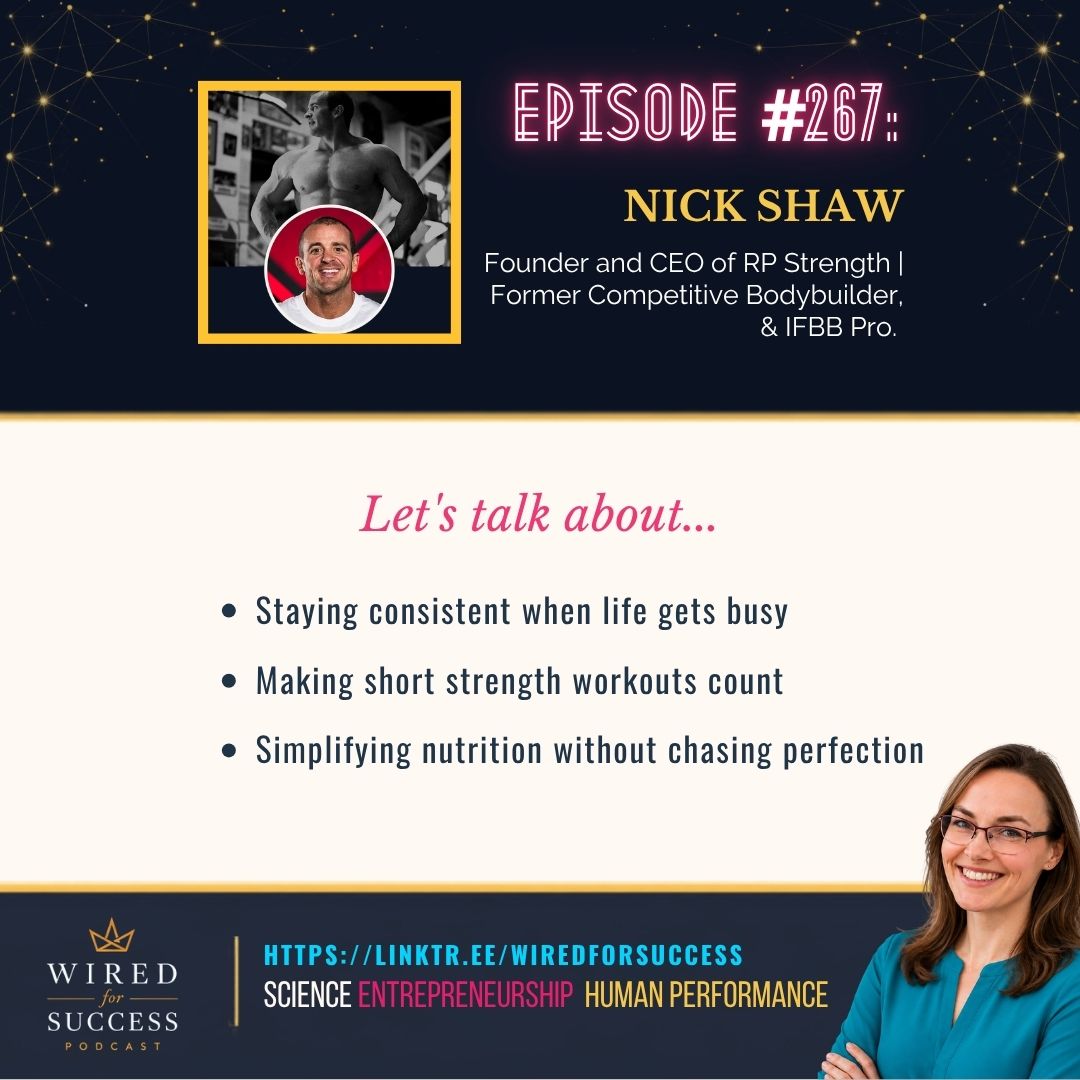
About Nick Shaw
Nick Shaw is the co-founder and CEO of RP Strength, formerly Renaissance Periodization. An IFBB Pro and former competitive bodybuilder, he has coached Olympians and CrossFit Games champions and helped develop training and nutrition apps. He is the author of Fit For Success and co-host of the RP Strength Podcast.
Human Performance
Explore conversations about training, mindset and wellbeing that help ambitious people build success while looking after themselves.
When a perfect plan becomes too much work
Nick Shaw once wrote a nutrition plan he was pretty pleased with. His client was one of the best CrossFit competitors in the world, with enormous training demands. He had worked out the details with impressive precision. Everything had its place.
Unfortunately, that place turned out to be mostly on paper. She couldn’t follow it.
She was moving house. Life was happening around the training, as life rather inconveniently tends to do. Nick had created something beautifully optimized that asked too much of the person expected to use it.
I appreciated how readily he called that a coaching failure. It takes some honesty to look at your carefully constructed plan and admit that the problem might be the plan.
As a scientist, coach and someone who likes fitting running and lifting into an already busy life, I find this question far more interesting than another debate about the perfect workout: how much optimization can we let go of to make something actually doable?
Maybe that means keeping a few reliable meals on rotation. Maybe it means protecting two realistic gym visits instead of writing down five ambitious ones and spending the week feeling behind.
You still want a plan that supports your goals. But if following it requires a different job, fewer children and a personal chef, we may need to revisit the brief.
What happens when research and real life disagree?
RP Strength grew out of Nick and Mike Israetel’s interest in combining scientific knowledge with practical athletic experience. I called them nerdy athletes during our conversation. As combinations go, I’m very much in favor. Give me someone who enjoys both a good study and a good workout. 😉
But what happens when the research points one way and a coach keeps seeing something different with clients? I wanted to know how Nick handles that tension.
His answer was to consider the accumulated evidence alongside what happens in practice. That sounds sensible, although the scientist in me immediately wants to ask a few more questions.
If a client improves, what caused it? The exercise selection? More consistent training? Better sleep? Several changes at once? Seeing a result is useful. Knowing why it happened is a trickier business.
Experience can help us spot something worth investigating. It can also make us very attached to an explanation we happen to like.
So I asked Nick about cherry-picking studies. His suggestion was to ask a coach why they recommend a particular approach. I’d add another question: what would make you change your mind?
That answer interests me much more than how confidently someone can explain their favorite method. Confidence is easy to find in the fitness industry. A willingness to reconsider takes a little more looking.
Only 20 minutes to train? Let’s work with that.
I asked Nick what he would have me do with three 20-minute training windows in a week. His suggestion was to pair movements such as a bench press and a pulldown, alternating between exercises that emphasize different muscles.
In other words, make the time you have useful. You don’t have to abandon the whole session because the hour you wanted has mysteriously become 20 minutes.
There’s research behind that general approach. A 2021 narrative review by Iversen and colleagues discusses prioritizing multi-joint exercises and using supersets to save time. It also makes a useful distinction between training efficiently and maximizing every possible adaptation. Those are different goals.
What I wouldn’t take from this is an invitation to sprint around the gym collecting exercises. Choose familiar movements, warm up appropriately and allow enough recovery to keep your technique solid. And if your plan requires occupying three machines in a crowded gym at six o’clock, your fellow gym-goers may have some feedback.
Nick mentions fitting around 20 sets into a short session. I’d treat that as his illustration, rather than a number everyone needs to chase. Especially after a break, I’d be more interested in whether you can do useful work, recover and come back again.
One other point from this running enthusiast: getting breathless while lifting doesn’t automatically cover all your aerobic activity needs. WHO guidance includes both aerobic activity and muscle strengthening. There’s still room for a walk, a bike ride or, if you’re so inclined, a lovely run.
Even the fitness professional can struggle to get back into it
One of my favorite moments was Nick admitting that getting back to training felt difficult after just two weeks away because of an injury and illness.
This is someone who has lifted for decades. Fitness is his work. He doesn’t usually struggle to find the motivation. And yet, there he was, finding the restart surprisingly hard.
That gave him a little more appreciation for what it might feel like to walk into a gym after years away. The exercises, the equipment, the people who all seem to know what they’re doing… it can be a lot before you’ve even picked up a weight.
Nick has also built his environment around training. He works from home and has a home gym. That’s helpful context when we hear about his six-day routine. School drop-offs, a commute and a busy commercial gym create a rather different scheduling puzzle.
I’d take inspiration from how deliberately he makes room for training, while choosing a schedule that fits your own circumstances.
If you’re restarting, decide what you can realistically do next week and give yourself a fallback if something gets in the way. You don’t have to squeeze a month of missed workouts into your first session back. Your legs will probably have opinions about that.
Can we make protein easier without turning lunch into homework?
Nick’s main nutrition suggestion was to make a protein source easy to reach when the day becomes unpredictable. A normal meal, a convenient snack, something you’ve thought about before the back-to-back calls begin.
I can get behind making a useful decision easier. Waiting until you’re ravenous and staring into the fridge rarely feels like the moment for thoughtful nutritional planning.
First, though, a small correction from our conversation: one gram of protein per pound of body weight works out to approximately 2.2 grams per kilogram, rather than 1.8. Even podcast conversations occasionally need a calculator.
How much do you actually need? Morton and colleagues’ meta-analysis looked at protein supplementation alongside resistance training in healthy adults. Their model estimated that additional gains in fat-free mass leveled off around 1.6 grams of total daily protein per kilogram, with uncertainty around that estimate.
That’s useful context for muscle-building goals. It doesn’t mean more protein always improves health, or that everyone needs to start buying supplements. Personally, I aim for around 1 to 1.5 grams per kilogram of body weight. That’s my own target, rather than a prescription for everyone reading.
I also couldn’t resist questioning some of the excitement around products labeled “high protein.” I want to see what’s actually in a serving before I get too impressed by the packaging.
My own preference is for straightforward foods and plain protein powder. I’m not particularly keen on artificial sweeteners or long lists of added ingredients. That’s a preference, rather than proof that every unfamiliar ingredient is harmful. Convenience can be useful; I just want to know what I’m paying for beyond a very enthusiastic label.
Your body and someone else’s Instagram photo
Our conversation also took a candid detour into bodybuilding, performance-enhancing drugs and the physiques we see online.
This is where I want to be clear about something: looking impressive and being healthy are different questions. The Endocrine Society describes substantial health risks associated with performance-enhancing drug use. Treatment for a diagnosed medical condition needs to be distinguished from nonmedical enhancement, and regular blood tests cannot establish that enhancement is safe.
Nick offered his perspective during the interview, including some broader reassurance about monitoring. I wouldn’t treat that reassurance as medical guidance.
For most of us, the more immediate issue is what happens when we use someone else’s physique as the standard for our own progress. A photograph doesn’t come with a full history of their training, genetics, lighting, editing or possible enhancement.
And you’re looking at that photograph while trying to build a business, look after a family and decide what’s for dinner.
Admire the dedication if it inspires you. Then come back to what you want from your own training and which trade-offs you’re comfortable making. You’re allowed to want strength, energy and good health without adopting the life of a professional bodybuilder.
Takeaway
I keep coming back to Nick’s story about the nutrition plan. He knew his subject. He cared about doing a good job. He had put real thought into the details. And he still needed to step back and make it easier for his client to use.
That feels familiar well beyond fitness.
If work has pushed your health habits aside, look at the week coming up. Where could training realistically fit? What could you have ready to eat on the day that usually goes sideways?
Try that version and see what happens. If the same part keeps falling apart, get curious about it. Does the session take too long? Is the food inconvenient? Are you relying on energy you simply don’t have at that time of day?
We’re often willing to investigate a process that isn’t working in our businesses. We can bring some of that patience and curiosity to ourselves, too.
You have enough going on. Your fitness plan should give you a workable way to look after yourself within that life.
Want to steal my systems?
I’ve distilled the habits, tools and resources I use to stay happy, healthy and productive—even when life gets messy—into one free guide.
Steal what works. Ignore what doesn’t. Build a system that works for your life.
FULL EPISODE
Listen to the full conversation
Hear Nick’s coaching stories, his approach to short strength workouts and what two weeks away from training taught him about starting again. We also explore evidence-based fitness, protein habits and the comparison trap.
Research & further reading
- Iversen and colleagues (2021), No Time to Lift? Designing Time-Efficient Training Programs for Strength and Hypertrophy — Sports Medicine. A narrative review of ways to reduce training time and their limitations.
- Morton and colleagues (2018), Protein supplementation and resistance-training adaptations — British Journal of Sports Medicine. A meta-analysis of trials in healthy adults.
- World Health Organization, Physical activity — context for aerobic activity, strengthening and sedentary time.
- Pope and colleagues (2014), Adverse Health Consequences of Performance-Enhancing Drugs — an Endocrine Society scientific statement on health risks and gaps in knowledge.
Continue exploring
- How Many Carbs Do Endurance Athletes Really Need? — Aaron Gouw on matching nutrition to the work you actually do.
- Why Are Entrepreneurs More Vulnerable to Mental Health Problems? — Michael A. Freeman on ambition, wellbeing and founder health.
- Explore more Human Performance episodes
Music credit
“Vittoro” by Blue Dot Sessions
sessions.blue
Disclaimer
This podcast is for educational and informational purposes only and does not constitute medical or financial advice. Episodes may contain sponsored content.