
EPISODE #264 · HUMAN PERFORMANCE
Why Are Entrepreneurs More Vulnerable to Mental Health Problems?
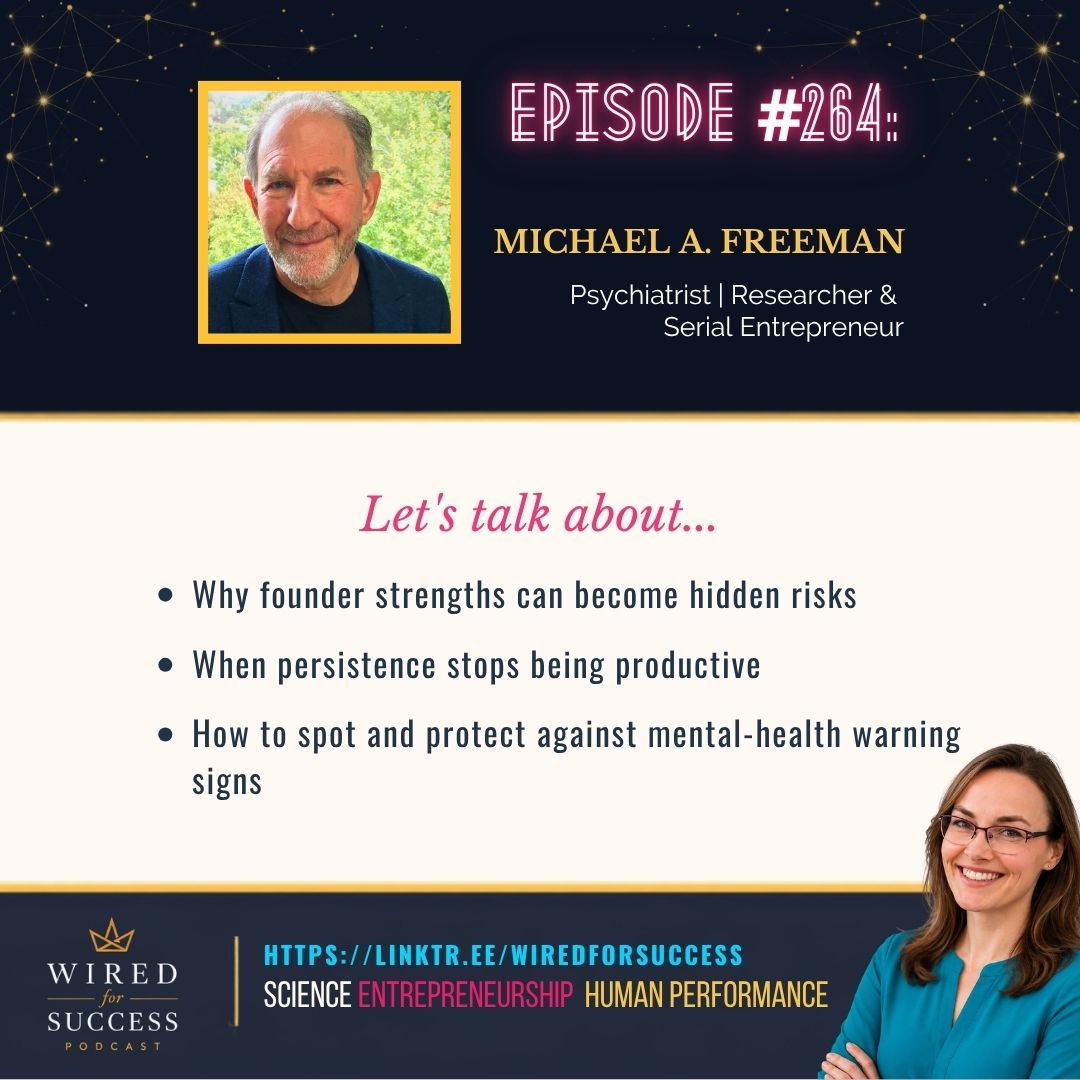
The drive, optimism, risk tolerance and persistence that help founders build remarkable companies can also distort judgment, strain relationships and push them past healthy limits. Psychiatrist, researcher and serial entrepreneur Michael A. Freeman explains what the evidence actually says about founder mental health—and how entrepreneurs can protect themselves without pathologizing ambition.
ABOUT THE GUEST
Michael A. Freeman, M.D.
Michael A. Freeman, M.D. is a psychiatrist, researcher and serial entrepreneur who studies mental health, wellbeing and performance among business builders. He and his colleagues at Econa developed the Founder Screen, a brief screening tool designed specifically for entrepreneurs. Michael has also served as a Clinical Professor of Psychiatry at U.C. San Francisco, founding Chief Medical Officer of United Behavioral Health, President of the Institute for Behavioral Healthcare and a mental-health team member of the White House Task Force on Health Care Reform.
EXPLORE MORE
Human Performance
Explore conversations about mindset, resilience, mental health and sustainable performance—without sacrificing your health, relationships or humanity along the way.
The entrepreneurial mind is a strange piece of equipment.
It can spot an opportunity where everybody else sees a mess. It can move before all the evidence is neatly arranged, tolerate uncertainty and keep going long after a more cautious person has wandered off in search of a reliable salary and fewer cortisol spikes.
Those qualities can build a company. They can also create spectacular problems.
That was the tension I wanted to explore with psychiatrist, researcher and serial entrepreneur Michael A. Freeman: can a founder’s mind be both the company’s greatest asset and its biggest hidden risk?
Michael has spent years studying entrepreneur mental health and wellbeing. Our conversation ranged from dopamine and impulsivity to burnout, emotional contagion, investor access to mental-health data and the deceptively difficult question of when a determined founder should finally stop persisting.
The study everybody quotes—and what it cannot tell us
If you have spent any time reading about founder mental health, you have probably encountered one of the dramatic statistics attached to Michael’s work.
In a study of 242 entrepreneurs and 93 comparison participants, 49% of the entrepreneurs reported at least one lifetime mental-health condition, compared with 32% of the comparison group. The entrepreneur sample also reported higher rates of depression, ADHD, substance-use conditions and bipolar disorder.
Those figures matter. But they are not a diagnosis of entrepreneurship itself.
The study used self-reported histories and a non-representative convenience sample. It found associations, not proof that entrepreneurship causes mental-health conditions—or that a particular condition makes somebody a better founder. Michael’s own answer was more nuanced: some people may enter entrepreneurship with pre-existing vulnerabilities, while the uncertainty, risk and chronic pressure of building a company can also trigger or amplify problems.
In other words, predisposition meets environment. As a biologist, that makes far more sense to me than any neat “founders are born different” headline. Traits, nervous-system sensitivity, workload, sleep, support and the current state of the business all interact. There is no single founder brain setting marked SUCCESS—convenient though that would be.
Michael described entrepreneurs as more dopaminergic, connecting dopamine-related traits with motivation, novelty seeking, learning and reward. I find that an interesting framework, but I would treat the sweeping neurochemical explanation as a hypothesis rather than a settled conclusion. The prevalence study measured reported psychiatric histories; it did not measure dopamine activity in entrepreneurs’ brains.
That distinction does not make the conversation less interesting. It makes the right question sharper: which traits help in a given context, and when do those same traits begin to impair judgment, relationships or health?
Every strength has a failure mode
Take impulsivity.
An entrepreneur rarely gets the luxury of perfect information. The ability to decide quickly can prevent analysis paralysis and keep a young company moving. But the same speed can become recklessness—and, as Michael pointed out, one or two impulsive decisions can do serious damage to an entire business.
Persistence has a similar double life. Founders are praised for refusing to quit, sometimes to an almost comical degree. Yet stubbornly pursuing an idea after the evidence has changed is not resilience. It is refusing to update the experiment.
Michael’s reframing was one of my favorite parts of the conversation: entrepreneurship is hypothesis testing.
You see a problem. You form a theory about a useful solution. Then the market responds, usually with much less tact than a peer reviewer. If the hypothesis fails, the job is to learn whether you need a better version, a different approach or the courage to stop.
That changes failure from a verdict on the founder into information about the experiment. It also creates a more intelligent definition of persistence: keep going while the evidence still supports another useful test—not merely because quitting would bruise your identity.
Whatever happens inside the founder enters the company
Founder mental health is often treated as a private wellbeing issue. It is not.
A founder’s judgment shapes hiring, strategy, risk and resource allocation. Their emotional state affects conversations, conflict and culture. Teams often notice irritability, recklessness, withdrawal or wildly changing decisions before the founder recognizes a pattern.
Michael described emotions as contagious. That does not mean every difficult day becomes a company crisis; founders remain human and are allowed moods. But when chronic stress repeatedly changes how the leader interprets information and treats other people, the distinction between “personal” and “business” becomes rather theoretical.
The feedback loop also runs in the opposite direction. A struggling company can leave one founder curious, another anxious and a third almost paralysed. The event matters, but so do the person’s interpretation, physiology, recovery capacity and available support.
This is why founder wellbeing belongs in business infrastructure. Sleep, exercise, relationships and recovery are not fluffy extras pasted onto the serious work. They influence whether the person making the highest-leverage decisions can still think clearly.
The warning signs Michael named were refreshingly ordinary: persistent dissatisfaction, disconnection from family or community, cynicism, futility, sleep loss, panic, rumination, recklessness, repeated mistakes and feedback from trusted people that you are no longer on your game. None of those automatically proves a clinical condition. They are signals worth investigating before “push through” becomes the entire strategy.
Can two minutes create a useful early warning?
Michael and his colleagues developed the Entrepreneur Well-being Check, a seven-question screen designed to assess mental health, wellbeing and occupational functioning in entrepreneurs. In the validation study, 314 entrepreneurs completed the measure and related assessments, with follow-up testing six months later.
The results were promising: the seven items formed a single factor and showed good internal consistency and several forms of validity, with fair test-retest reliability. The limits matter too. The research relied on a self-selected sample and the authors explicitly note that the findings await replication.
A screening tool is not a diagnosis. Its value lies in noticing distress early enough to do something useful about it.
I was particularly interested in privacy. Michael was unequivocal: the individual result is confidential, the development team cannot see it, the data is not for sale and the entrepreneur decides whether to share it with a clinician, coach or trusted person. He argued that investors should not receive individual screening results—not least because they may misinterpret sensitive information through stigma or simplistic assumptions.
That boundary is essential. A tool intended as a safety net could quickly become a source of surveillance if access drifted from founder to funder.
Recovery that actually removes your brain from work
The practical recommendations were not exotic: protect sleep, exercise, maintain relationships outside work, use cognitive reframing or mindfulness and take restorative breaks.
Simple is not the same as easy.
The part I liked most was Michael’s advice to choose an activity cognitively demanding enough to jam the business channel. Cooking a four-course dinner, rock climbing, surfing or cycling with friends can work because you cannot simultaneously give the activity proper attention and continue mentally editing tomorrow’s strategy deck.
That is a better test of recovery than whether an activity appears on a wellness checklist: did your brain actually leave the business for a while?
And if emotional symptoms are affecting performance, wellbeing or relationships, Michael’s closing advice was equally clear: ask for help. Entrepreneurs already build teams of accountants, lawyers, consultants and coaches. Adding the right mental-health professional is not an admission that you have failed at entrepreneurship. It is another way of giving yourself—and your company—a better chance of functioning well.
Takeaway
The most useful idea in this conversation is not that entrepreneurs are uniquely broken or secretly superhuman. It is that context changes what a trait does.
Drive can become compulsion. Confidence can become poor risk calibration. Persistence can become refusal to learn. The aim is not to sand away every intense or unusual quality that makes somebody entrepreneurial. It is to build enough self-awareness, recovery and honest feedback around those qualities that they remain assets more often than liabilities.
That feels both more scientifically honest and more humane than glorifying suffering as the price of ambition.
Want to steal my systems?
I’ve distilled the habits, tools and resources I use to stay happy, healthy and productive—even when life gets messy—into one free guide.
Steal what works. Ignore what doesn’t. Build a system that works for your life.
FULL EPISODE
Listen to the full conversation
Listen for a nuanced discussion of founder mental health that neither pathologizes ambition nor romanticizes genuine suffering. Michael and I explore the evidence, the business consequences, early warning signs, privacy and the practical habits that protect long-term performance.
Research & further reading
-
The prevalence and co-occurrence of psychiatric conditions among entrepreneurs and their families
Freeman MA, Staudenmaier PJ, Zisser MR, Andresen LA. Small Business Economics, 2019. -
The entrepreneur well-being check: a screener for entrepreneur mental health and well-being
Freeman MA, Mazza A, Johnson SL, Heinz AJ. International Journal of Entrepreneurial Behavior & Research, published online 2025; volume 32, issue 5, 2026. -
Entrepreneurs’ mental health and well-being: A review and research agenda
Stephan U. Academy of Management Perspectives, 2018.
Continue exploring
-
Can AI Actually Tell Us How to Live Better?
AI, biomarkers and the limits of personalised health data with Reiner Kraft, Ph.D. -
Spiritually Intelligent Leadership
Purpose, presence and sustainable leadership with Dr. Yosi Amram. - Explore all Human Performance episodes →
Music credit
“Vittoro” by Blue Dot Sessions
sessions.blue
Disclaimer
This podcast is for educational and informational purposes only and does not constitute medical or financial advice. Episodes may contain sponsored content.